
Charles City Projected Versus Actual
A projected release date is a calculation for a future custody end. It may be based on the active sentence, presentence jail credit, earned credits, good conduct, and the way multiple sentences run. It is not proof that release occurred. The actual release record is created when the custodian completes the event and records what happened next.
Pretrial RRJ detainees do not have a sentence-completion date because no active sentence has been calculated. Their possible release depends on bond, dismissal, plea or sentence, and later court orders. A scheduled court date is not a release date. A sentenced person can have a computed date, yet another warrant, detainer, court amendment, disciplinary event, or transfer may prevent release to the community.
- Projected date
- An agency calculation that can change before the event.
- Actual release
- The completed end of one custodian’s hold, recorded after execution.
- Detainer
- A request or authority that can lead to continued custody or transfer.
- Presentence credit
- Qualifying time in custody credited toward an imposed sentence.
Find Charles City Projected Release
Begin with the custodian. Charles City local detention is handled through Riverside Regional Jail in North Prince George. A local sentence remains an RRJ and court matter unless VADOC assumes authority. A state-prison sentence belongs to VADOC. The county printed on the case does not make every date a county-jail date.
For state custody, use the VADOC Inmate & Supervisee Locator. Search by the first three letters of the first name and full last name, or use the seven-digit DOC ID. The exact public result-card release-date label remains unverified in the August 8, 2026 research. Do not describe a field as “Projected Release Date” or “Expected Release Date” unless the current live record actually uses that label. Treat any displayed date according to the agency’s wording and confirm it with VADOC.
- Identify whether the person is pretrial, serving a local RRJ sentence, or under VADOC authority.
- For VADOC, search by DOC ID when possible and confirm the institution or district location.
- Read any public date exactly as labeled, record the access date, and keep it separate from a completed release.
- For a local sentence, ask RRJ which office holds the official computation and request the relevant existing record.
- Check the Charles City final sentencing order for imposed time, suspended time, and credit direction.
- Confirm the later event through RRJ or VADOC rather than turning the projection into a release claim.
Note: A VADOC daily-update warning means a very recent change should be checked again or confirmed directly with corrections staff.
Charles City Release Calculation Channels
Virginia divides release computation by sentence and custodian. VADOC says the local or state authority calculates based on active time and sentence type. VADOC calculates an active earned-sentence-credit sentence over 12 months. It also calculates parole eligibility, mandatory parole, or good-time release for qualifying parole-eligible good-conduct sentences over that threshold.
RRJ applies the local-jail framework to a qualifying local sentence. The jail’s written credit policy matters, as does the final Charles City court order. A family calculation based only on the sentence length is unsafe because it can miss presentence credit, concurrent or consecutive terms, mandatory minimum time, forfeited credits, a court amendment, or another hold. The clean access path is to ask the responsible custodian for its own current computation record.
VADOC explains the division of authority on its official page. Review VADOC time-computation rules before referring to the captured screen below.
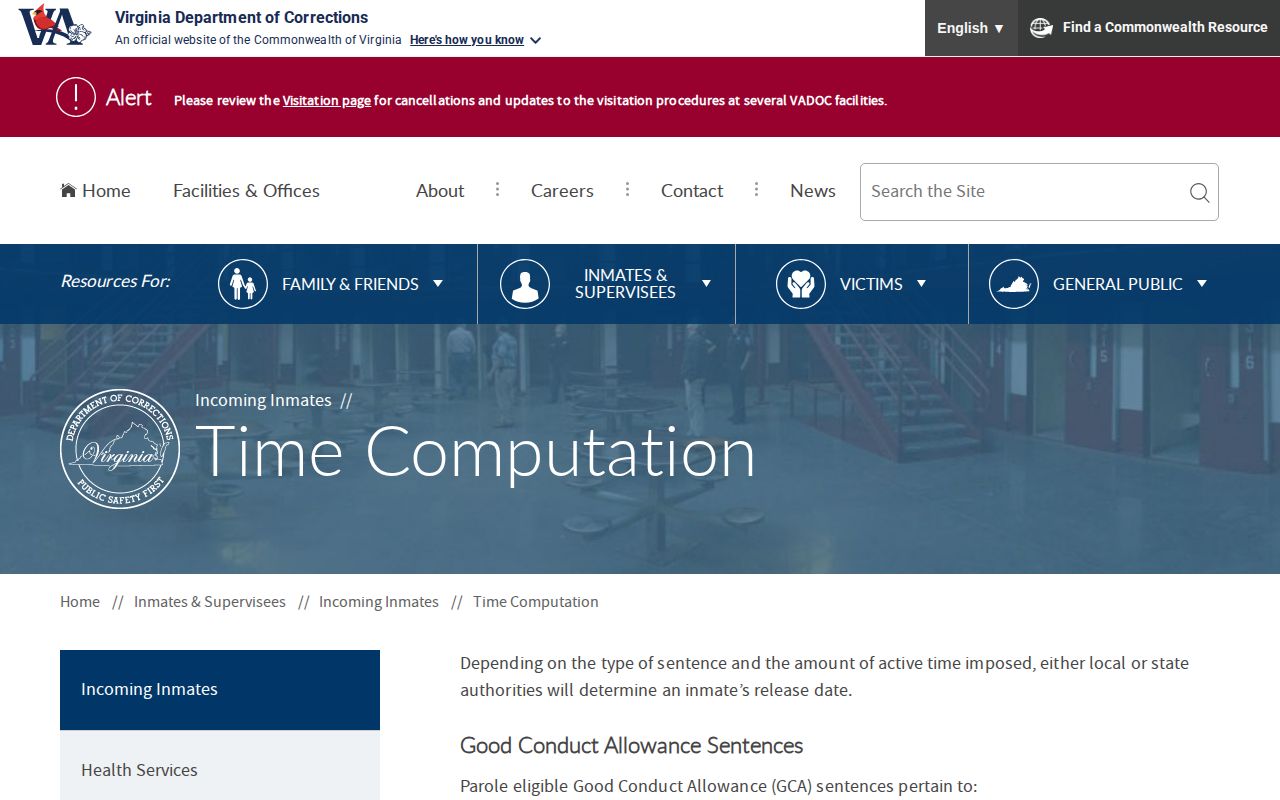
The screen confirms the agency’s computation role. It does not supply a date for a person or replace the current individual record.
Virginia Credits Shape Charles City Release
For qualifying felonies committed on or after January 1, 1995, Virginia Code § 53.1-202.2 and § 53.1-202.3 govern earned sentence credits. One earned credit deducts one day. Current law caps listed serious or excluded offenses at 4.5 credits per 30 days served. Other eligible offenses can use classification rates of 15, 7.5, 3.5, or zero credits per 30 days.
Classification can change. VADOC reviews it at least once a year, and removal from a program, job, or education assignment can affect the class. Credits do not shorten the wait to parole eligibility. The popular phrase “serve 85 percent” is only a broad truth-in-sentencing description. A 4.5-per-30 rate works out to about 86.96 percent physically served, while current law can allow higher rates for other eligible offenses. Never promise an exact 85 percent outcome.
Offense, statutory tier, sentence structure, conduct, classification, and calculation all control the date. The statute in effect for the sentence must be checked. Earned credits can reduce active time, but they do not erase a detainer or override a later court order.
Note: Virginia earned-credit tiers are legal limits and calculation inputs, not a safe do-it-yourself release-date formula for a named person.
RRJ Good Conduct Release Credit
A different rule applies to certain short local sentences. Under Virginia Code § 53.1-116, a person sentenced to 12 months or less for one or more misdemeanors generally earns one good-conduct day for each day served, including qualifying presentence jail time, if the sentence has no mandatory minimum and the person follows written jail rules.
RRJ must maintain a written credit policy, and RRJ is the proper source for its calculation. This rule should not be applied to a pretrial person, used to override a mandatory minimum, or treated as the VADOC felony system. Post-1994 felony credits cannot exceed the Article 4 allowances. Ask RRJ for the official current calculation rather than publishing an estimate from an online docket.
Local and state credits can appear in the same broader case history when someone first spends time at RRJ and later enters VADOC. Presentence credit may follow the person into the state calculation, but only the responsible authority can reconcile the orders and custody dates.
Why Charles City Release Dates Move
A projected date can move in either direction as the official record changes. VADOC Operating Procedure 050.3 calls for final review of warrants, detainers, court orders, disciplinary or classification changes, and uncalculated sentences that may affect release. These checks help explain why an earlier estimate may no longer match the planned date.
| Factor | Possible effect | Best source |
|---|---|---|
| Presentence jail credit | Changes credited active time | Final order and custodian computation |
| Concurrent or consecutive terms | Changes how terms are combined | Court orders and VADOC Court & Legal |
| Credit classification | Changes the rate of future earned credit | VADOC computation record |
| Disciplinary loss or restoration | Removes or restores eligible credit | Custodian record |
| Court amendment | Changes the sentence authority | Signed court order |
| Warrant or detainer | May cause continued custody or transfer | Custodian and receiving agency |
| Parole decision | May authorize a later supervised release | Board report plus VADOC event |
A Virginia Parole Board Grant is not physical release. It precedes VADOC execution of the release and any community-supervision entry. Likewise, a Not Grant is a decision at that time, not a universal computation of every future date.
Charles City VADOC Computation Help
A person under VADOC authority can ask the agency about its own computation. VADOC directs computation correspondence to its Correspondence Unit and Court & Legal Section. Include the person’s full name and DOC ID, identify the date or field being questioned, and ask for the current agency record or explanation. Do not ask staff to create a speculative date from an incomplete sentence summary.
VADOC Correspondence Unit / Court & Legal SectionP.O. Box 26963
6900 Atmore Drive
Richmond, VA 23261
(804) 674-3000
docmail@vadoc.virginia.gov
The final sentencing order is essential when a computation appears wrong. Compare the case number, imposed and suspended terms, presentence credit direction, and whether terms run at the same time or one after another. VADOC can reconcile the order with intake and disciplinary records. The Charles City clerk can provide a certified order, but the clerk does not perform VADOC’s time calculation.
When a result displays a future date, preserve its exact label and the access date. Ask whether the date is current, what sentence it addresses, and whether an uncalculated term or hold remains. A response about one sentence should not be generalized to every case or custodian. If a court later amends the order, request a new computation instead of relying on the former result.
Keep the projected date in a dated custody ledger. Place the sentence order, credit calculation, any later amendment, and actual custody event on separate lines. That format exposes a moved date without erasing the older source and makes clear which agency supplied each fact.
VADOC Charles City Release Day
VADOC’s facility-release guidance says discharge or parole from a VADOC institution occurs by 11:59 p.m. on the release date, weather permitting. Staff arrange approved pickup or public transportation and return property and documents. Business staff may arrange bus travel. These are statewide prison procedures.
Do not apply that rule to RRJ. Riverside Regional Jail has not published the same release-hour promise or a public pickup schedule. A Charles City local detainee and a VADOC prisoner have different custodians and different release logistics, even when both cases began in Charles City. Confirm instructions with the facility holding the person.
Confirm Charles City Actual Release
When the projected day arrives, return to the source that holds custody. RRJ can confirm its own completed event through an existing custody or release record. VADOC can provide state release documentation, including an applicable Order of Release, Conditions of Probation, or Conditions of Parole. The state locator may later show a probation and parole district office, which points to physical prison release with ongoing community supervision.
Virginia VINE can send an RRJ custody event alert if registration occurred while the record was active. Its event must be read exactly, because transfer is not release. The Charles City County VINELink inmate search explains registration and the break between local VINE and VADOC notification. For the full records chain, use the Charles City County released inmates record path.
A completed record should identify four facts: system, event, date type, and next custodian or supervision status. If one is unknown, state that limit. This keeps a projected date, Board action, court order, or missing roster result from being misreported as an actual release.